


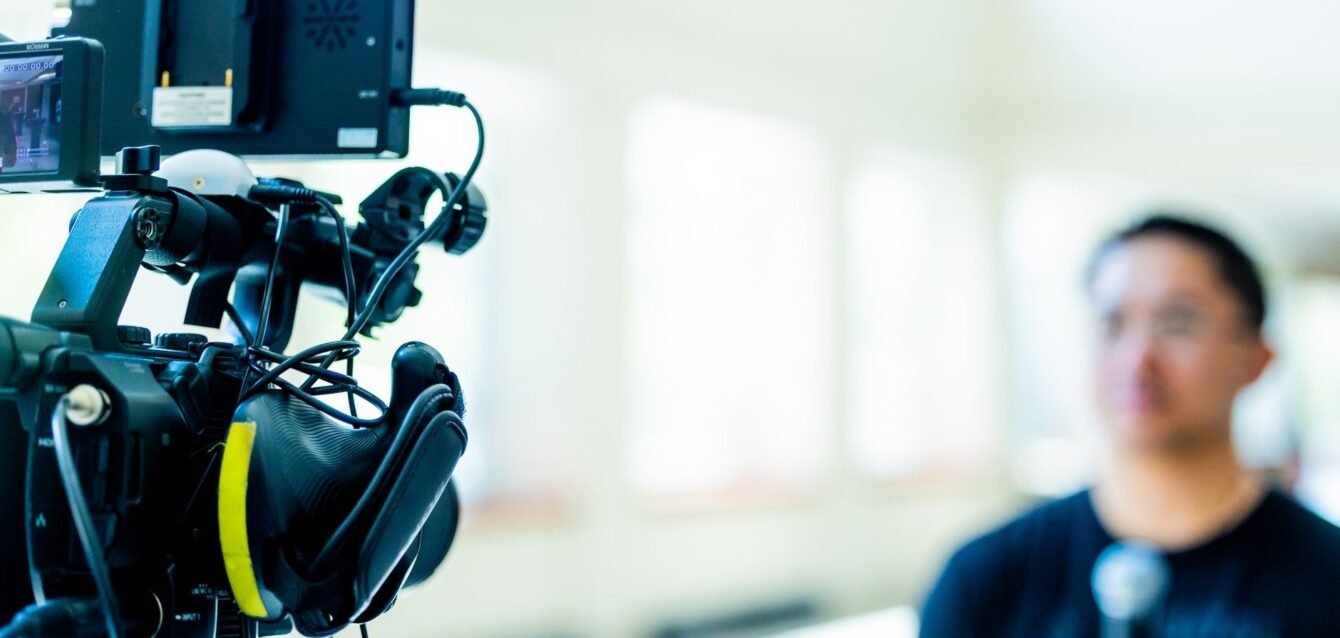
It’s natural to be worried about being on camera, that’s why I often spend more of my time behind it. We specialise in working with founders who hate being on camera and we make sure we work closely with you to prepare you and make you feel as comfortable as possible during filming, whilst making sure we get the best answers and content on the day.
This is how that works in practice when filming founders, and most of it will help even if we’re not the ones filming you.
If you’re wondering whether you need to be on camera at all, the short answer is that buyers and investors are backing a person as much as a technology, which is an argument made properly in belief or evidence. You explaining why you left a research career for this is often the single most persuasive asset the company owns, and nobody can do it for you.
Why founders freeze on camera
None of this is about being bad at talking, because you’ll happily explain your technology across a table, in a meeting, at a whiteboard, for an hour without notes. Those situations have a listener and a conversation, and the camera appears to have neither. The freeze comes from being asked to perform rather than to explain, and almost every fix that follows works by turning the performance back into an explanation.
That also means the problem is the process rather than the person, which is worth saying out loud to anyone who’s worried about a shoot coming up. We have never met a founder who could not do this once the setup stopped asking them to act.
No scripts, no autocue
Reading an autocue convincingly is a skill that takes years to build (watch a newsreader’s eyes), and a founder reciting lines comes across exactly like someone reciting lines, which is worse than no video at all. So nothing we shoot starts from a script.
Everything runs as an interview instead. Questions come from behind the camera, the founder answers them the way they would in conversation, and the edit builds the film out of the answers. The founder already knows this material better than anyone else in the room, so the job of the questions is to get it out of them in their own words, phrased so each answer stands alone without the question attached. We send the questions over a few days ahead with a note asking people not to write answers out, because a thought-about answer sounds like the founder and a written-then-memorised answer sounds memorised.
Work before interviews
The day is ordered so that everyone is filmed doing their actual job before anyone sits down to talk, hands and equipment and screens and the real task, and the ordering is doing two jobs at once. That working footage is the proof a technical buyer wants to see anyway, and an hour of being filmed while concentrating on something else is what makes the camera stop being an event, so by the time the interview starts, people have usually forgotten to be nervous.
The same footage is also the safety net under every answer, because the edit can cut away to it at any point, which means a stumble mid-sentence costs nothing and everybody can be told so truthfully. How the whole day gets ordered, and what to settle in the week before it, is covered in how to prepare for a deep tech video shoot.
The first twenty minutes is often cut
Almost nobody is good in the first twenty minutes of an interview, including people who do this regularly, so we treat that stretch as a warm-up and say so at the start: every answer can go again, stumbles get cut, nothing anyone says is wasted. Once a bad answer costs nothing, the good answers start coming, and the usable material nearly always arrives after the point where the founder has stopped monitoring how they sound.
If someone else is filming you
None of the above is proprietary, so if you are being filmed by another crew, or by a colleague with a phone, the same three things are worth insisting on. Ask to be interviewed rather than handed lines, ask for the working footage to be shot before your interview rather than after it, and agree out loud at the start that early takes are disposable. A crew that resists all three is planning to point a camera at you and hope, and the result will be the stiff founder video that sits unused on a homepage.
When the founder should not be the face
Some founders never get comfortable on camera, and a decent amount of the time that is fine, because mild awkwardness from someone who obviously knows their subject reads as expertise rather than weakness, and technical buyers can tell the difference between performance and knowledge. The version that does not work is when being filmed is clearly making someone miserable, and when we see that we say so and change the plan rather than pushing through.
There are two alternatives. A voiceover-led film can carry the founder’s thinking in their own recorded words without ever putting their face on screen, and it loses less than people fear. Or the team carries it instead, because an engineer explaining their corner of the technology with evident care often does more for a buyer than a founder performing confidence, and a company that looks staffed with capable people is its own argument. What nobody needs is media training, which teaches people to sound trained, and we would rather you spent that budget on anything else.

What this produces
A founder interview run this way gives the edit far more than one film, because self-contained answers become the short clips that carry a LinkedIn presence, the cutdowns that answer specific buyer questions, and the human thread through a homepage film, all from the same sitting. Our full approach to video for deep tech companies, including how founder material fits the wider asset plan, is in the deep tech video guide, and the service itself lives on the services page.
Once you stop treating the founder interview as a performance to survive and start treating it as a conversation that happens to be filmed, with the work shot first, the questions doing the heavy lifting and the first twenty minutes thrown away, the camera problem mostly dissolves, and what comes out is the version of you that already convinces people across a table every week.
FAQ
Do founders need media training before being filmed?
No, and for interview-led filming it tends to make things worse, because media training teaches people to deliver messages and the camera reads that as performance. Answering questions about your own technology is something you already do in every meeting, and a good interview process draws on that instead of replacing it.
What if I hate how I look and sound on camera?
Almost everyone does at first, partly because you are used to hearing your own voice from inside your head. The practical fixes are process ones: being filmed working before being interviewed, knowing early takes are disposable, and answering questions rather than reciting lines. Comfort follows from those, not from willpower.
Does the founder have to be the face of the company video?
No. A voiceover-led film can carry the founder’s thinking without putting them on screen, and engineers explaining their own corner of the technology are often more persuasive to technical buyers than a founder performing confidence. The wrong answer is forcing visibly miserable footage into the edit.
How long does a founder interview take to film?
Around forty five minutes to an hour of sitting, of which the first twenty minutes are usually a warm-up that never gets used. With the working footage shot beforehand, that single sitting typically supplies the main film plus a set of standalone clips.